Assistance to homeless persons enhanced by opening of community resource center

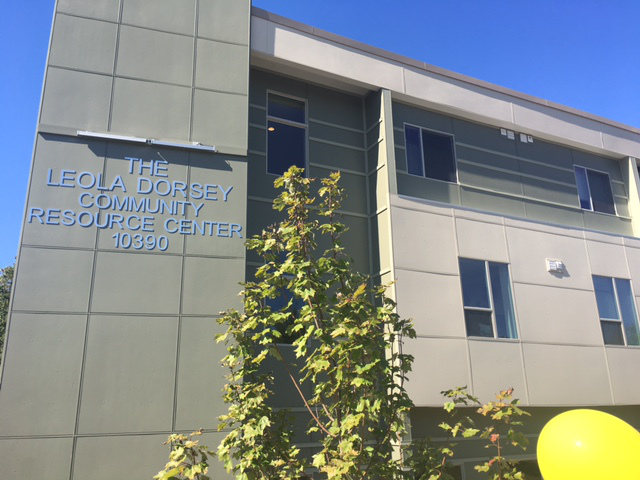
Howard County, Md. recently opened a new facility for homeless persons, the Leola Dorsey Community Resource Center.  It now houses the Day Resource Center that previously operated on Route 1, includes 35 apartments, and is based on an increasingly popular model for addressing homelessness called “Housing First.” Here is a primer on the new center and the challenge of homelessness in Howard County, Md.

(This post is an update of a previous HoCoMDcc post, “Howard County’s Latest Effort to End Homelessness”, June 21, 2016)

Howard County officials unveil Dorsey Community Resource Center

by Kate Magill (Howard County Times), October 2, 2017 [EXCERPTS]

Amid a crowd of nearly 100 people, Howard County Executive Allan Kittleman unveiled the Leola Dorsey Community Resource Center on Monday, joined by Howard County Housing Commissioner Peter Engel, state Sens. Gail Bates and Guy Guzzone and several other officials.
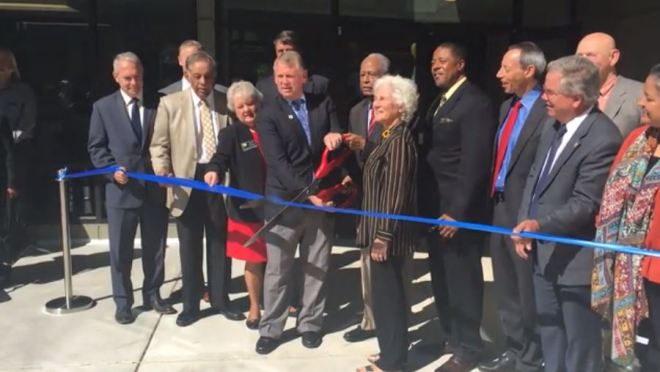
County Executive Allan Kittleman and Charles Dorsey, son of civil rights activist Leola Dorsey, cut the ribbon at the opening of the Leola Dorsey Community Resource Center on Oct. 2. (VOA Chesapeake)

The facility, located near Guilford Road in Jessup, includes 35 permanent residences [operated by Volunteers of America Chesapeake] and a first-floor day resource center, operated by Grassroots Crisis Intervention Center.

With its ability to serve more than 100 people a day, Engel noted that the center is able to serve at least half of the county’s homeless population on any given day. There were 214 homeless individuals in Howard County in 2016, according to state data.

Continue reading Assistance to homeless persons enhanced by opening of community resource center

The future of transportation is “Complete Streets”

Transportation has been in the news a lot lately. Governor Hogan announced his intention to spend $9 billion on a massive highway project. Howard County is holding public hearings on how to upgrade our public transit system. Columbia Association just held its annual BikeAbout. And Horizon Foundation is holding its Open Streets event Sunday October 1st.

We need to think of these aspects of transportation as an integrated whole or else we’ll waste a lot of money without fully supporting our community needs. Contrary to Governor Hogan’s approach, Howard County has committed to a “Complete Streets” policy, and the Open Streets event will demonstrate what that is.  Here I attempt to make sense of it all. Continue reading The future of transportation is “Complete Streets”

Howard County is a bicycling community – Join the fun!

As temperatures cool, more and more people are bicycling, for fun, exercise, and basic transportation. Howard County provides numerous opportunities to join the movement. There are several events coming up in the next few weeks and organizations that are devoted to cycling. Our transportation infrastructure is changing to support a more walkable and bikeable community. Bicycles are now available on demand for short trips around Columbia.

Come join the fun. There are no excuses not to. Continue reading Howard County is a bicycling community – Join the fun!

Substance abuse is prevalent in Howard County. What are we doing about it?

Actually, Howard County is not unusual in the extent of our substance use and abuse. And like everywhere else, addiction follows for too many of us. Whether addiction is to a licit or illicit drug, the results to one’s well-being are much the same.  Given that addicts are from all walks of life, all income groups, all races and creeds, it’s difficult to argue that imprisonment is the best solution. And most folks need help to recover from an addiction. Here’s a primer on addiction and what help is available in the HoCo.

Prevalence of Substance Use in the United States

According to SAMHSA’s [Substance Abuse and Mental Health Services Administration] National Survey on Drug Use and Health (NSDUH) – 2014 (PDF | 3.4 MB), about two-thirds (66.6%) of people aged 12 or older reported in 2014 that they drank alcohol in the past 12 months, with 6.4% meeting criteria for an alcohol use disorder. Also among Americans aged 12 or older, the use of illicit drugs has increased over the last decade from 8.3% of the population using illicit drugs in the past month in 2002 to 10.2% (27 million people) in 2014. Of those, 7.1 million people met criteria for an illicit drug use disorder in the past year.

The misuse of prescription drugs is second only to marijuana as the nation’s most common drug problem after alcohol and tobacco, leading to troubling increases in opioid overdoses in the past decade. An estimated 25.2% (66.9 million) of Americans aged 12 or older were current users of a tobacco product. While tobacco use has declined since 2002 for the general population, this has not been the case for people with serious mental illness where tobacco use remains a major cause of morbidity and early death.

[The Substance Abuse and Mental Health Services Administration (SAMHSA) is the agency within the U.S. Department of Health and Human Services that leads public health efforts to advance the behavioral health of the nation. SAMHSA’s mission is to reduce the impact of substance abuse and mental illness on America’s communities.]

https://www.samhsa.gov/atod

Location hunt underway for county’s first detox center

by Kate Magill (Howard County Times), July 18, 2017 [EXCERPTS]

As Maryland continues its battle against opioid abuse, Howard County is taking steps toward opening its first residential detoxification center, something officials say is desperately needed and overdue. Continue reading Substance abuse is prevalent in Howard County. What are we doing about it?

How government and nonprofit services came to be in HoCo

Forty-six years ago, as rural Howard County was being inundated by Columbia, a three-day charrette was held to consider what human service needs should be addressed by government and nonprofit organizations. Organized by the Association of Community Services and Howard Community College, the charrette was attended by some 335 people, including citizens, providers, community leaders, new Countians and old Countians. 

They overcame distrust, suspicions and competing interests to reach consensus on a report that is excerpted here. Many ideas were visionary, others just practical, some misguided. The goals they outlined are a measure of how far we’ve come in nearly half a century, and point to what more we have to do to create the city and county that James Rouse envisioned  – a place that provides for the growth of people.

It all started with James Rouse

In 1969, James Rouse created the Columbia Foundation [now the Community Foundation of Howard County] the first community foundation in the state of Maryland.  He and members of the founding board had the prescience to realize that the new town of Columbia would continue to grow and attract new residents and would have pressing needs for decades to come.

[James Rouse stated], “We have always envisaged bringing into being the coordinating leadership, on a continuing basis, to overlook the quality of life of the city; assert entrepreneurial initiative to bring into being new institutions as required; encourage existing institutions to spread their services to areas not covered or avoid unnecessary duplications”.

[In] 1971, the Foundation awarded its first grant to the Association of Community Services of Howard County to “explore human services needs and possible approaches.”

http://cfhoco.org/about-cfhoco/history/ Continue reading How government and nonprofit services came to be in HoCo