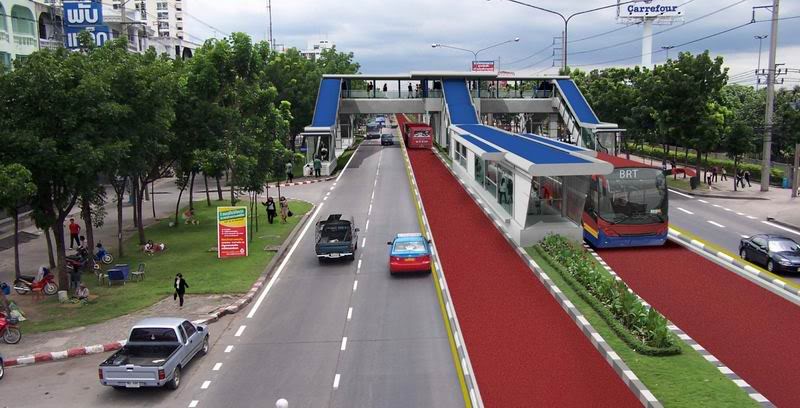
Howard County has few transportation options for people traveling into DC. Bus Rapid Transit (BRT) may be a relatively inexpensive option.
Montgomery’s bet on an ambitious Bus Rapid Transit system hinges on Route 29
By Luz Lazo (Washington Post), May 13, 2017 – ABRIDGED
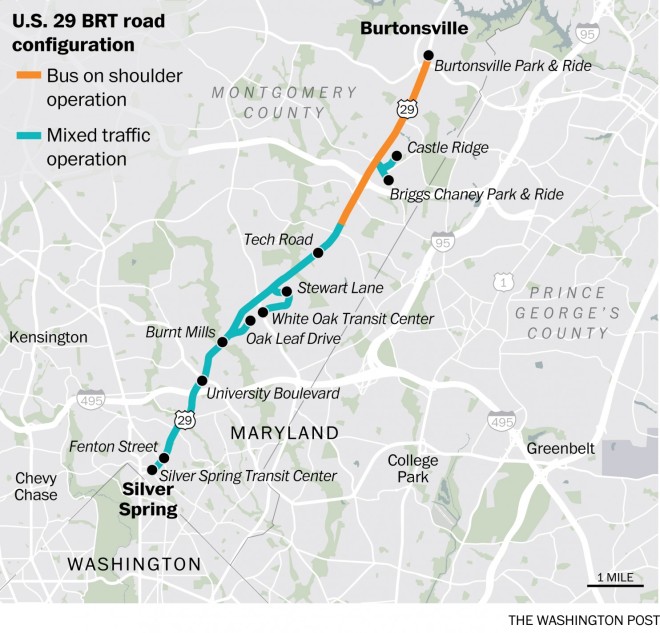
Montgomery County’s years-long plan to build a 14-mile Bus Rapid Transit (BRT) line on one of Maryland’s busiest commuter corridors appears to finally be moving from idea to reality.
County Executive Isiah Leggett (D), who has championed BRT as the county’s next major transit undertaking, included $21.5 million for the project in his capital budget. A County Council committee earlier this month signaled its support for the BRT project, voting to send the plan to the full council for approval of funding for the design phase, putting the project one step away from construction — and closer to a 2020 opening.
The plan as it stands would put buses on shoulder lanes for a portion of the route, but also in regular traffic. This decision, which sacrificed earlier plans to have a reversible HOV lane in the southern portion of the route, cut capital costs by more than half to $31.5 million. Officials say the money will pay for new stations, buses, and new bike and pedestrian infrastructure. The county’s portion will be matched with a $10 million federal grant.
John Swinglish was a great man. I met him in 1973 when we were both involved with the Catholic Peace Fellowship near Catholic University in DC. During this time, he put his life on the line to oppose the Vietnam War.
I lost track of him about 10 years ago until I learned he died suddenly in early April. His friends will miss him for the quality of his friendship, his easy rapport, and unmistakable laugh. The world is a better place for his witness. It is a story that must not be forgotten.
Obituary
[Posted 5/12/17; Updated 8/26/17, 9/19/17]
John Swinglish was found dead at his home in Odenton, MD from “hypertensive cardiovascular disease” on April 12, 2017. He was 73. John was born March 25, 1944. He was adopted by Aloysius and Jean Swinglish and grew up in Lakewood, OH near Cleveland where he attended St. Edward High School. In the early 1960s he enlisted in the Navy and served with Attack Squadron VA-42 at the Naval Air Station in Oceana, Virginia Beach, VA.
Following his military service, John came to Washington DC to work for a defense contractor doing research on nuclear guided-missile destroyers. But he became more and more disillusioned with the country’s war effort and became active with the Catholic Peace Fellowship at DC’s Emmaus House around 1968, attempting to influence the Catholic Church to re-establish its priorities.
In 1971, John was indicted, along with 27 other antiwar activists, for conspiracy to break into a Selective Service office in Camden, NJ and destruction of government property. The group came to be known as the Camden 28. Following a landmark trial that lasted 63 days, the 28 were found not guilty on all charges. The acquittals represented the first legal victory for the antiwar movement in five years of such draft board actions and prosecutions. The jury’s verdict moved Supreme Court Justice William Brennan to call the proceeding “one of the great trials of the 20th century.”
Following the trial, John returned to DC and transformed Emmaus House into a neighborhood social service center which he directed until 1982. On September 11, 1976, John married Mimi Darragh of McDonald, Pennsylvania. They divorced about seven years later and there were no children.
John later worked for the American Red Cross, providing emergency and disaster services, and founded his own photography business specializing in weddings and family events. He said, “I’ve finally figured out a way to get people to pay me to go to wild parties every week. It’s really not a bad life.” John was a featured narrator in the film, The Camden 28, which was released in 2007. He promoted the film widely and was proud of his contribution. He also contributed to the documentary Hit and Stay, released in 2014, about the efforts of the Catholic Left.
John was active in the Center of Light Church in Bowie and assisted with the youth groups there. He was a life-long reader and frequent writer and enjoyed road trips and Bowie Baysox games. After retiring, he devoted his life to befriending dogs of all kind as a dog sitter. John had a stroke in 2010 and was challenged by various ailments through the remaining years of his life.
John was predeceased by his parents and a sister, Jan Weiskittel of Columbia Station, Ohio. He is survived by Jan’s children Laura McDermott, Larry Weiskittel, Bob Weiskittel, Kati Emrick, and Joe Weiskittel, all of Ohio; Sharyn Carrasco of Texas; and Patti Leonard of Illinois. John is also survived by his goddaughter, Carrie Noel-Nosbaum of Silver Spring, MD. A memorial service was held on August 26, 2017 at the home of Ray and Ruth Noel-Nosbaum, Silver Spring, MD.
by Harry Schwarz, gleaned from a number of sources
The Shrine 6, arrested for nonviolent resistance
On Monday night, November 10, 1969 at the National Shrine of the Immaculate Conception the U.S. bishops [attending a meeting in Washington DC of the National Conference of Catholic Bishops] were attending a Mass in honor of the military. Billed as a “Peace Mass,” it featured military men carrying guns and swords around the Shrine as if it were one of their armories.
Outside, members of the Center for Christian Renewal and the Catholic Peace Fellowship were distributing leaflets and displaying large photographs depicting Viet Nam war atrocities. The leaflets protested “the prelates of the church which claims to have been founded by Jesus Christ walking hand in hand with the ‘Masters of War’ through the National Shrine of the Immaculate Conception.” The Christian Peace Message being distributed further protested the contemporary U.S. bishops acting as “the voice of Christ today,” yet choosing to “lie low, safely refraining from any strong statement condemning the hate, killing, and total dehumanization of our war-programmed society.”
The peace messengers had been displaying the photographs and distributing the leaflets for about· a half an hour when they were told by a Shrine usher that he was authorized by the administrator of the Shrine to halt any demonstrating or leafleting on Shrine property. A police officer then read the D.C. Code stating that they were subject to arrest if they did not stop at the usher’s request. “Our argument was that we, as Catholics, have a right to speak out on moral issues on Catholic Church property,” stated John Swinglish; “however, at his request, we did cease distributing literature, and we removed the photographs.”
Approximately fifteen minutes later, Joseph Coleman and John Swinglish, of the Catholic Peace Fellowship were arrested while standing in front of the shrine talking to two other members. The Shrine usher and police officer approached them and told them to leave since they were in possession of the peace literature. They refused to leave, stating that they “are Catholics and have a right to be on church property.” The usher stated that he had the right to tell anyone whom he did not want on Shrine property to leave. The officer read the D.C. Code and asked Coleman and Swinglish if they were going to leave. When they refused, they were arrested.
from The Catholic Peace Fellowship Bulletin, June 1970
The Camden 28
From a pamphlet that the defendants published about themselves
“We are twenty-eight men and women who, together with other resisters across the country, are trying with our lives to say no to the madness we see perpetrated by our government in the name of the American people the madness of our Vietnam policy, of the arms race, of our neglected cities and inhuman prisons. We do not believe that it is criminal to destroy pieces of paper which are used to bind men to involuntary servitude, which train these men to kill, and which send them to possibility die in an unjust, immoral, and illegal war. We stand for life and freedom and the building of communities of true friendship. We will continue to speak out and act for peace and justice, knowing that our spirit of resistance cannot be jailed or broken.”
Written, directed, and produced by Anthony Giacchino
The Camden 28 recalls a 1971 raid on a Camden, N.J., draft board office by “Catholic Left” activists protesting the Vietnam War and its effects on urban America. Arrested on site in a clearly planned sting, The Camden 28 reveals the story behind the arrests — a provocative tale of government intrigue and personal betrayal — and the ensuing legal battle, which Supreme Court Justice William Brennan called “one of the great trials of the 20th century.” Thirty-five years later, the participants take stock of the motives, fears, and costs of their activism — and its relevance to America today.
Howard County is creating a model of collaboration for the delivery of human services. The New Howard County Nonprofit Center has opened at Patuxent Woods Drive in Columbia. My post about the plans for the Center is here. The offices will soon be part of a larger Community Resources Campus when several Howard County government offices move to adjacent buildings.
The Campus will be a one-stop shop for folks in need of assistance. It is centrally located at Broken Land and Snowden River Parkways, and is on several RTA bus routes.
Proximity can serve to enlarge the world view among participants and foster innovation, for the benefit of the organizations and the clients. It requires the commitment of the agencies to make it happen, and our encouragement.
Nonprofit center model comes to Columbia
by Fatimah Waseem (Columbia Flier), April 28, 2017
A vision floated more than two decades ago to bring local nonprofit organizations and human service agencies under one roof is materializing in a small corporate park in Columbia.
Two drone operators, LRogers1096and JONTBMXhave posted on YouTube several aerial videos of Columbia and Howard County. These are my favorites. If you want to subscribe to be informed of future videos by these folks, click on the links above.
“Go West, Young Man” June 04, 2007|By Rob Hiaasen (Baltimore Sun)
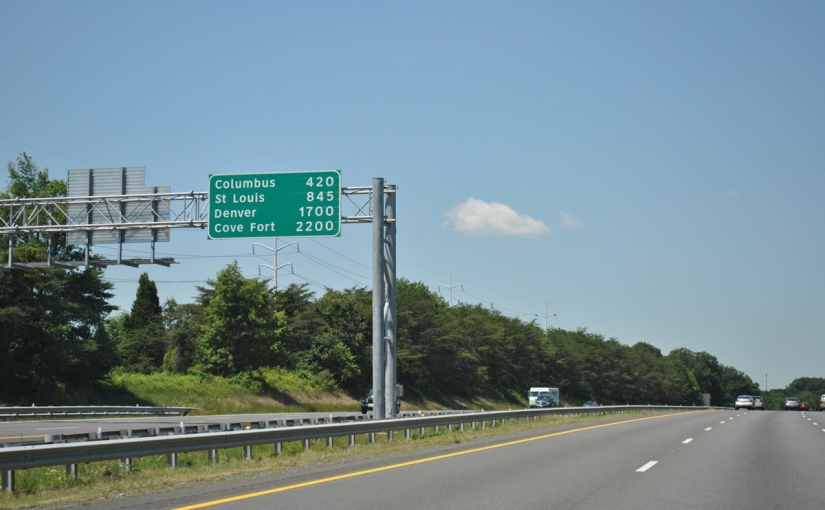
. . . . Tom Hicks, a state highway administrator in Maryland, decided to immortalize Cove Fort [the western terminus of I-70, in Utah] in the minds of Marylanders heading west out of Baltimore toward Frederick, Hagerstown and across nine other states connected by I-70. He and another highway man, Paul Farragut of the Baltimore Metropolitan Council, got to thinking about a different kind of mileage sign, one with a bit of geographical whimsy and one that, for more practical reasons, would test a new type style. It’s not often an act of traffic engineering captures the imagination of, well, anyone.


 Following his military service, John came to Washington DC to work for a defense contractor doing research on nuclear guided-missile destroyers. But he became more and more disillusioned with the country’s war effort and became active with the Catholic Peace Fellowship at DC’s Emmaus House around 1968, attempting to influence the Catholic Church to re-establish its priorities.



 HoCoMDcc