Kimco’s proposal for redevelopment of the Hickory Ridge Village Center is to be considered by the Howard County Design Advisory Panel next Wednesday December 7. Like the rest of Columbia, the issue of increased urbanization at this central community hub is at the heart of controversy.
I support the plan. In the face of continued population growth, suburban sprawl and development of more and more of our natural lands are not sustainable. Higher densities in appropriate locations throughout Columbia is smart growth, will promote public transit, and will serve to improve pedestrian and bicycle amenities. Two of my previous posts about this subject are here and here.
Citizens In favor of a Vibrant Village Center (CIVVC)
Many of us have attended the public meetings Kimco has held and been disturbed by both the tone and substance of the comments made by many in opposition to the plan. The level of uncertainty, fear, and worst-case scenarios has been high in these meetings.
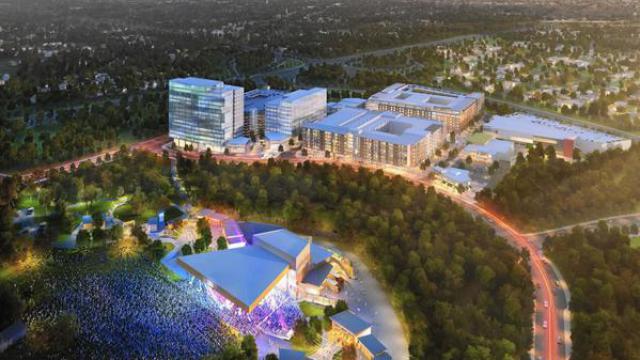
Residents of Columbia, Maryland are objecting to the increased urbanization that is developing in the Downtown. Alas, it means cutting down a lot of trees that long-time Columbians have gotten used to. But suburbia is not sustainable, and perhaps Jim Rouse, the founder of Columbia, knew this. He always intended that Columbia have a real downtown and he set aside the land surrounding Merriweather Park at Symphony Woods, known as the Crescent (pictured above), for this purpose.
Increased densities in appropriate locations throughout suburbia, such as the Crescent and the Village Centers in Columbia, are the right thing to do. Here’s why:
My grandparents, John and Marie Schwarz, were Baltimore antique dealers from at least 1925, until my grandmother liquidated the business in 1985. John took over the family business when he was about 25, located on Antique Row, 827 N. Howard Street, and moved it some years later to 2013/2015 North Charles Street. My grandfather was known throughout the Mid Atlantic and New England as a leading expert in the decorative arts and assisted in the development of that portion of the American collection at the Baltimore Museum of Art.
Papa John and Dede brought together all of our extended family, and I grew up having great times hanging at their antique store. So many magical and fascinating googahs and places to hide for small people. I honored my grandparents for their business savvy and was counted on to help with accounting at times. I delivered holiday orders one December when I was 20, learned my way around Baltimore, and was introduced to some of its wealthiest neighborhoods. I was even with them at times as they traveled New England, buying antiques at small shops and auctions.
My grandmother continued managing the business after Papa John died in 1966, with the help of their daughter, Ann Keene. Antique furniture has infused all of our family. It enriches my artistic sense.
A primary goal for Crescent is to create a sustainable, urban live/work neighborhood overlooking Merriweather-Symphony Woods. This neighborhood will be unique to Downtown Columbia, with tall office and residential towers set on the periphery within new development parcels on the high ground between lower, environmentally-sensitive areas.
One of the neighborhood’s greatest assets is its natural setting with preserved and enhanced woodlands and tributaries to Symphony Stream and Little Patuxent River. And, while the developed areas will be fairly dense, the park setting, the curvilinear roads, and the rolling topography will set Crescent apart from the other Downtown neighborhoods.
A sustainable built environment will be created through the creation of mixed-use development with amenity spaces that allow residents to socialize, work, shop and play; the design of complete streets where residents can walk or bike to destinations or public transit; the design of buildings that are healthy and use natural resources more efficiently; and the creation of a healthy environment with clean water, clean air, and increased connections to the natural environment.
Orchard Development selected Design Collective to generate an innovative vision for a new performing and visual arts center with multi-family housing above, in Downtown Columbia, Maryland. Aspiring to become central Maryland’s paradigm for a community arts hub, the performing arts center will house Toby’s 350-seat Dinner Theater in-the-round, 2 black-box theaters, dance rooms and a full service restaurant. The visual arts wing will house the Howard County Arts Council which will include galleries, artist-in-residence studios, classrooms and offices.
In collaboration with the Howard County Housing Commission, 210 residential units will sit above the arts uses, concealing a 700-space garage, with a third-level residential amenity program featuring rooftop courtyards that overlook Symphony Woods and Merriweather Post Pavilion. At the confluence of Downtown and the preserved Woods, this merging of arts and residency will add new life and become a community anchor for Columbia.
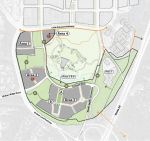
Site Plan, Crescent Neighborhood (Crescent Neighborhood Implementation Plan, Howard Hughes Corporation) – including open spaces and new street grid.
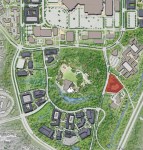
Aerial Site Plan, Crescent Neighborhood (Design Collective) – the new Columbia Arts Center, where Toby’s Dinner Theater is currently located, is highlighted in red.
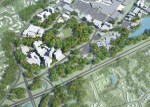
3D Aerial, Crescent Neighborhood (Design Collective) – including Merriweather at the center, Mall at the top, Lakefront at the right, and US29/Broken Land Pkwy interchange at lower left.
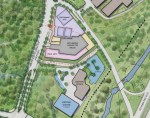
Site Plan, Area 1, Crescent Neighborhood (Howard Hughes Corporation)
Entrance Court, South side of Building A, Crescent Neighborhood (Design Collective)
Area 1, Crescent Neighborhood, looking North (Design Collective) – these office buildings and parking deck are currently under construction at corner of Little Patuxent and Broken Land Pkwys.
Area 3, Crescent Neighborhood looking south (Design Collective) – the new Central Library, Food Hall, and parking deck is far right
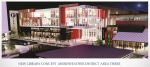
Central Library Concept, Area 3, Crescent Neighborhood (Howard Hughes Corporation)
Conceptual Retail site plan (Howard Hughes Corporation)
Conceptional Residential Site Plan (Howard Hughes Corporation)
Artist’s representation, Area 3, Crescent Neighborhood (Howard Hughes Corporation)
Area 3, Crescent Neighborhood, with Merriweather in the foreground and US29 upper left (Design Collective)
Area 7 Site Plan, Crescent Neighborhood (Design Collective)
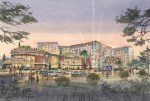
Columbia Arts Center, Area 7, Crescent Neighborhood (Design Collective)
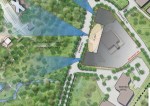
Columbia Art Center relation to Symphony Woods (Design Collective) – The Butterfly guest services building is upper left
Ground floor site plan, Columbia Arts Center, Crescent Neighborhood (Design Collective)
Upper floors site plan, Columbia Arts Center, Crescent Neighborhood (Design Collective)
Public Charter Schools have the potential to improve our education of elementary and secondary school students. I’ve learned this from my work the last eight years facilitating more effective financial management of these schools. It is disappointing, therefore, that Maryland/Howard County has made so little commitment to Public Charter Schools. It is equally troubling that there is not better understanding of what charter schools are.
I have found that the agencies operating Charter Schools, like the nonprofit world in general, range from ineffective but well-intentioned, to cutting edge and well-managed. The former schools need to be closed by the authorizer. The latter need to be replicated for the good of all our kids. But there are real obstacles to charter schools achieving their potential in Maryland. Here’s a primer on what Charter Schools are all about.







 HoCoMDcc